by Dwayne Phillips
I learn a few things about learning environments.
I recently attended a conference on innovation in education at George Mason University. I am not a professional educator and, to be candid, I never thought much about professional educators.
To show that I am not all cold hearted and stone headed, I learned a few things about Personal Learning Environments. These are basically web tools that allow a person to make their own Internet or their own portal to the Internet.
- Reclaim Hosting gives a student a web site with blog and just about everything else they could want for $12 a year – that is inexpensive.
- Symbaloo allows you to create a button interface to the Internet sites you like to use all the time.
I see great value in both these tools. Try them for yourself.
Tags: Education · Learning
by Dwayne Phillips
What is a typographical error?
Writing anything incorrectly when you know what is correct.
For example:
He nows how to type.
Their going to school.
I type as fast as I can when drafting. I make lots of typographical errors, and I don’t catch them all when editing.
Tags: Writing
by Dwayne Phillips
Sick people are harder to heal than healthy people. That sure makes everything more difficult, but that seems to be reality.
Have you ever noticed that sick people are harder to heal than people who are well?
Sick people have many problems. Those problems interact with one another in complex and often impossible-to-see ways. Putting a band-aid on one of those problems worsens another problem by placing adhesive tape over it. Then you have to jerk the band-aid off in a couple of days when the cut heals. Ouch, that hurts and it often rips some other skin.
Consider a person who is overweight and wants to go on a diet. You know what they say,
Check with your physician before beginning an regimen of exercise and diet.
The doctor is afraid that the diet will affect your high blood pressure and its medication. The exercise might be good for your heart, but would aggravate the strained ligaments in your knee.
Hence, the person does not go on a diet and does not lose weight. They are too sick to get well.
I suppose I should relate this to projects or business or groups of people. The relation is pretty simple,
Once an endeavor has many problems, it becomes almost impossible to correct any one problem.
The answer is the same boring, fundamental one:
Pay attention everyday and prevent problems instead of trying to correct them.
Sorry, no universe-changing advice today.
Tags: General Systems Thinking · Health · Problems
by Dwayne Phillips
Some people seem to get in the way. Perhaps I am not seeing them well.
You know the type. You have met many of these people. They always seem to get in the way.
I know what is right. I know which way the organization should go. There is, however, one person who holds up progress. They want to analyze something one more time. They have yet another list of stupid questions that only waste time and prevent progress.
That person is in my way.
Perhaps (just perhaps, just something I might consider) I am not seeing them correctly. Perhaps my view of progress is blocking my view of the person.
Consider:
- Progress – an artificial goal, something I cannot touch, some concept.
- The other person – a human being.
Now, which is more important? Uh, er, uh, well, you know. I mean…
ooops. Now let’s reconsider the situation and pay attention to people. Perhaps (just perhaps, just something I might consider) that other person has something important to say and do and be and I am an ogre who puts things in front of people.
Rats.
Tags: People
by Dwayne Phillips
In addition to the planner’s basics, talk directly to the right people in a frank manner.
Years ago, I worked with a company VP who had success on the vast majority of his projects. His “secret” was:
- Plan your work (in detail)
- Work your plan (track progress in detail)
Okay, big deal. I had heard this clever little phrase first in 1980 (yes, I am that old).
This successful VP, however, had one more step:
- Talk directly to the right people in a frank manner.
Hmm. There are several parts of this extra step:
- Talk – face to face with words
- Directly – not around the corner by triangulating rumors with people
- Right – you have to know who the right person is which means you have to know what is happening
- People – not talking to the wall or to the PowerPoint or to the…
- Frank – candid, honest, open, no riddles, no hints
There is much to this extra step. This VP did all those things, and he succeeded. Funny, all those right people with whom he spoke directly in a frank manner also succeeded.
Also, this step acknowledges that accomplishing work comprises far more than plans on the wall. People perform the work. No people – no work. People have more to do in their lives than follow my silly little plan that is stuck to the wall. I have to work in those boundaries.
Why don’t we all do this all the time? Perhaps we don’t want to know the answer to that.
Tags: Communication · Management · People · Planning
September 30th, 2013 · No Comments
by Dwayne Phillips
Disagreements often fall under the cliche, “we are in violent agreement.” Go past the quick decision and converse with the other person.
Joe: I disagree with you.
Moe: Really?
Joe: Yes.
Moe: Are you sure?
Joe: Yes
Moe: Let’s step through this to ensure that we disagree.
Joe: ?
Moe: Let me try to understand you better.
Joe: I can see where that would help you.
Moe: Yes, it would. Perhaps we actually agree.
Joe: ?
Moe: You are a smart person. I would be happy if I learned that we agreed.
Joe: ?
Moe: Let’s start with what I heard you say.
Joe: ?
Moe: Sometimes my thinking clouds my hearing. Let me tell you what I heard, and then you correct me if I am mistaken.
Tags: Communication
September 26th, 2013 · No Comments
by Dwayne Phillips
Every organization and endeavor is unique to a degree, but not absolutely unique. Learn the prior experience of each person and find a way to benefit from it.
Like many of my (hi)stories, this one is from yet another experience with morons in government. I had 20 years experience in the larger organization, but learned that everything that I had learned in those years was worthless.
“Your prior experience doesn’t apply here,” I was told.
It seems every person new to this little niche was told the same. We were all worthless in the eyes of those who had been in the office at least one week longer than us.
Arrogance? Yes, the epitome of it.
Every person who walks in the door has prior experience. All those experiences sum to a major part of that person. If you are employing that person, you are employing their prior experience. To deem that prior experience inapplicable means you hired a worthless person. Who wants to hire a worthless person?
Part of a leader’s job is to learn the prior experience of each person and find a way to benefit from it. If you can’t do that, or even try to do that, quit your job and go somewhere else.
Tags: Learning · Management · People
September 23rd, 2013 · No Comments
by Dwayne Phillips
I present one technique I use to edit writing from others and myself.
There are various techniques for editing writing. Here is one that I use more than any other.
I reformat the paper in a word processor with a 0.3″ margin on the left and a 3″ margin on the right. The result looks like the image shown (the image is blurred for privacy of the unedited writer – in this case, me).
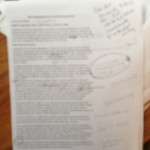
A Page Being Edited
Now I have room to write on the piece of paper.
I do two things:
- edit in the small
- edit in the large
For number (1), I correct the typos and adjust little phrases and words that could be better. For number (2), I create an after-the-fact outline of the paper. Number (1) is pretty standard, so I won’t spend many much time on it dawdle (see how that works?).
Number (2) is based on the concept that the paragraph is the unit of writing. I read that somewhere, and it seems to work. In the wide right margin, I write a short statement describing what I read as the topic of the paragraph. Once I do this for the entire paper, I can read the outline or progression of the paper. I gain a good feeling for the flow of the paper. Does it make sense? Does it jump back and forth too much?
Another way that number (2) helps me is it shows me paragraphs that have more than one topic. I believe, born of experience and reading advice from people who know much better than me, that each paragraph should have one topic. Mixing topics in paragraphs confuses readers, and I strive for minimal confusion.
This technique has some downsides. One is that I have to use paper to do it. I have yet to find a way to do this on the screen. Advice about that is welcome. Another is that after editing on paper, I have to go to the computer and repeat the edits. I hate doing the same thing twice. Again, advice on how to combine these two steps to one is welcome.
As the title states, this is one editing technique. It works for me most of the time.
Tags: Writing
September 19th, 2013 · No Comments
by Dwayne Phillips
I have been using a new writing technique lately in which I set a timer for uninterrupted writing, followed by a five-minute break, followed by another timed writing period.
There are countless writing techniques. My advice for these techniques:
Try the technique. If if works for you, use it. Otherwise, forget it.
I attach an addendum to this:
A technique may work for a while for a particular type of writing.
I have been using a technique lately that works for me. The technique:
- write 25 minutes without interruption
- take a 5-minute break
- write 25 minutes without interruption
- take a break for several hours
I use my iPhone as a timer. Important note: once I start the timer, I put it where I cannot see it. If the countdown is viewable, I am distracted by it.
During the 5-minute break, I walk away from the writing table. I usually stretch my hands, arms, and back.
Step 4 is optional depending on what I have planned for the day. Sometimes I do steps 1., 2., 3., 2., 3., etc. for several hours.
Results: I write about 30% more content during the hour in steps 1. through 3. than when I wrote for one hour solid. I leave the explanation for the increased output to someone else.
Tags: Work · Writing
September 16th, 2013 · No Comments
by Dwayne Phillips
People used to use the phrase “reverse psychology” more than they do now. I suppose I act out reverse psychology a lot these days. I don’t, however, of it in those terms. I think of my actions in vastly different terms.
People used to say the phrase that sits atop this post. If you wanted someone to do X, tell them to do Y, and they will do X because they just want to goad you.
Somehow, I still use reverse psychology, but it isn’t the same. For example, I want someone to feel comfortable with me, to spend time with me. When they tell me they are going away for a while, I tell them, “Great. That sounds like a good thing to do. I hope you enjoy it.” They go away, enjoy themselves, and come back and spend more time with me.
Reverse psychology?
How about describing it this way: I want the best for them. I want them to enjoy their choices. They appreciate that and show their appreciation.
Reverse psychology?
I don’t think so. I think it is simply a gesture of good will and best wishes. Things seem to work for the best when I live that way – wanting the best for the other person.
Reverse psychology?
Maybe, but probably not.
Tags: Communication · Expectations

