by Dwayne Phillips
It was the spring of 2006. I had been in California visiting the Contractor for several days. I flew home on Friday, caught the usual cab, and walked into an empty house.
Adam, my youngest son, was playing in the high school jazz band. He was playing bass while his friend Arash was playing guitar. The South Lakes band was playing in a multiple-day band appearance in South Carolina. Karen, my wife, had driven down with Adam and Arash and they had spent several days there. They would return on Saturday evening.
Nathan, my second son, was somewhere. He usually did things with his friends on Friday afternoon. He worked at Champps on Friday evening with his shift beginning around 5 or 6 PM.
As usual for returning from a trip, I had a lot of work to do. Given the weekend schedule, I had decided to work my extra hours on Friday night. I was on the California time zone, so I felt I could work to 9 or 10 PM without becoming too tired to know what I was doing.
I decided to go to Champps for dinner at 5. Nathan would probably show up there while I was there. It would be the first chance of seeing him all week.
I walked into Champps and was escorted to the perfect seat for the evening. It was on the upper level closest to the kitchen. I sat and ordered a hamburger, fries, and soft drink. Not very original, but I wanted some beef and potatoes.
I sat, ate, and looked for my son Nathan. He wasn’t around. I wasn’t sure when he was supposed to arrive for his shift. Maybe he wasn’t to work this Friday evening. I could have been mistaken about his work schedule. I ate and waited.
Nathan walked into the kitchen area from a back or side door. I was happy to see him, but he didn’t notice me yet. I was also happy to see that he was happy to be at work. He greeted his co-workers with a smile and laugh, and they greeted him in a like manner.
As far as I could tell, Nathan didn’t notice me sitting in the area eating dinner. He served himself a bowl of soup – the one thing they could eat without charge – and went somewhere that I could not see him.
I returned to eating my dinner. My gaze went down to my food for a few moments and so did my thoughts. The next thing I knew Nathan was at my table, pulling out a chair, and sitting down with his bowl of soup.
My 19-year-old son, right in front of all his co-workers, had found me in a crowd and sat down to eat dinner with me.
This was the best dinner of my life.
I once wrote to a discussion forum on the Internet that the best thing a child can say to a father was either,
“Dad, watch me do this,” or “Dad, help me do this.”
One person, Weinberg, replied that he felt the best thing a child can say to a parent is, “Dad, –anything–.”
My son walked over and without speaking said, “Dad I want to eat dinner with you.”
Sometimes I read too much into events. I don’t think I am putting too much into this event. I took this is a sign that perhaps I had been a pretty good father all these years. This six-foot two young man, the kid who was born early on a Sunday morning in Warrenton, Virginia, he was okay with sitting with his bald, gray-haired, non-descript man who was his father.
This was perhaps the greatest compliment anyone had ever paid to me.
Maybe there will be a day when I will have such a moment with my other two sons. Maybe they would have done the same. Maybe Nathan would have done this regardless of what he thought of me as a father.
I may never know anything of these “maybes.”
I do know that one this evening Nathan carried his bowl of soup over to my table, sat, and ate dinner with me.
This was the best dinner of my life.
Tags: Family
by Dwayne Phillips
I reveal my concept for the spell-checking pencil. The technology is only five years away.
I’ve had this idea for years. Now is the time to reveal it to the world. Maybe someone will build it and send me a dollar or something for the idea. The idea is for a
spell-checking pencil
Here is how it works. The pencil – could be a pen or felt tip marker or white board marker – has an accelerometer in it. The accelerometer senses the motion of the pencil as it move across the paper. The pencil has another sensor that senses the friction of the pencil against a surface. This way, the pencil knows when it is being waved about in the air versus when it is being used to write.
The sensors understand the motion of the pencil on paper, i.e., they can tell what letters the writer is writing. The pencil understands the connections of the letters into words. The pencil also has a spell checker built into its on-board computer. When the writer writes a word with incorrect spelling, the pencil beeps or vibrates. A display on the side of the pencil shows the correct spelling of the word. The writer has the oppotunity to erase and write the word correctly.
To build this spell-checking pencil, we would need:
- an accelerometer that is really small
- a friction sensor that is really small
- a computer small enough to fit into the pencil
- a good spell checker
Item 1. doesn’t exist yet. I guess it is five years away. I think item 2. already exists. Item 3. doesn’t exist yet, but could in five to ten years. Item 4. already exists.
I have in interim solution to speed the development of this pencil. Instead of embedding the accelerometer, friction sensor, and computer into the pencil, we can put a ring or slip-on gadget on the pointer finger of the user. That gadget would have the accelerometer and friction sensor. That gadget would also have an RF device like a WiFi or Bluetooth that would communicate with a nearby computer. The nearby computer would have the spell-checker and display. A person’s laptop computer would suffice.
Okay, there it is. Someone out there go and build this thing. Would anyone want it? Yes, I would. I tend to write with pencil and pen and chalk and marker more than most people I know plus I tend to worry about spelling, so build it for me. It would also be useful to anyone in business or education who stands at a white board and embarasses themselves by missspelllling words on the board.
Tags: Ideas · Technology
by Dwayne Phillips
We do the things we do because we choose to do them from among all the other choices we have. These choices can be light hearted and they can be rather dark and scary.
I learned a few things about myself in the past couple of weeks. For one, I like writing more than I like drinking coffee. How do I know that? Simple, I have found myself allowing my coffee to go cold while writing. I would not stop writing long enough to take even one sip of the still-warm coffee. I reached for the coffee after I had finished writing. By then, the coffee was cold.
For another thing, I like doing almost anything with my grandson more than watching football – even more that watching the Super Bowl. How do I know that? Simple, when the Super Bowl was on live a few weeks ago, I spent the entire first half watching old Disney cartoons on old VHS tapes on an old TV with my grandson. He went home at half time (bed time for him). I went to bed as well.
So this is all pretty simple stuff. What do you like doing? You are doing it right now. If you are reading blogs, you like reading blogs more than you like everything else that you could be doing. You are reading blogs because you have chosen to do so.
This you-do-what-you-like-to-do concept can lead us into some dark places.
If you turn red and scream at people, that is because you would rather turn red and scream at people than do anything else you could choose to do.
If you bully people, that is because you would rather bully people than do anything else you could choose to do.
If you drink until you pass out, that is because you would rather drink until you pass out than do anything else you could choose to do.
Hmmm, I told you this could lead us into some dark places. Maybe we should concentrate on the light stuff like watching Disney cartoons. Then again, maybe we should spend more time considering the dark places we go and how must like going to those dark places. Otherwise, we would go to the other places we can choose to go.
Tags: Change · Choose · Excuses · Observation
by Dwayne Phillips
Short stories I have written are on sale at Smashwords.com under the name Dwayne Phillips.
In 2008 I wrote 53 short stories. It was a great experience. I am now moving these stories to smashwords.com. They are on sale for 99 cents each. I am posting a few each day. See my stories at this link.
Tags: Writing
by Dwayne Phillips
Contrary to the Lake Wobegon Effect, the average fill-in-the-blank-noun-for-a-person is average.
Something I recently realized:
The average fill-in-the-blank-noun-for-a-person is average.
Here are some examples:
- The average doctor is average
- The average teacher is average
- The average writer is average
- The average engineer is average
and so on.
This all contradicts the Lake Wobegon Effect whereby all the children in Lake Wobegon are above average. It also contradicts what I have heard about the U.S. Navy, or was it the U.S. Army or the U.S. Air Force, where all the officers are in the upper third. No one was ever able to answer “the upper third of what?” but that is beside the point.
No, sorry folks, but the average fill-in-the-blank-noun-for-a-person is average.
Now we can argue that the average doctor (MD) is smarter than the average lawn mower repairman. That may be true until you set a broken lawn mower in front of the two of them. At such a time…well you know.
This Law of the Average fill-in-the-blank-noun-for-a-person can be quite troubling for specialists. Yes, there are millions (?) of teachers in America, but there are far fewer Russian teachers than there are English teachers in America. Being the specialists that they are, the Russian teachers like to feel a sense of better than average. Sorry, the average Russian teacher is average.
If I thought long enough, perhaps I could find an exception to this Law of the Average fill-in-the-blank-noun-for-a-person. Perhaps the exception is that the average PhD engineer who blogs about odds and ends and averages is above average at something. On second thought, perhaps not.
Tags: Culture · Differences · Expectations · Ideas · Logic · People
by Dwayne Phillips
Some meetings are driven only by the calendar. We meet monthly or weekly or whatever just because a page falls from the calendar on the wall.
I’m going to a meeting tomorrow (or maybe its the day after?). The reason for the meeting?
the calendar
Yes, it is a meeting determined by the calendar. We “have to meet” every month (or is it every week or two weeks or quarter or…?).
Now, I admit that there are meetings that should occur per the calendar. There are monthly budget reviews and monthly project reviews. These, however, or coincidentally ruled by the calendar. For example, a monthly project review occurs every month if the project can careen out of control in one month. If the project can careen out of control in two months and not in one, you hold a project review every two months. The same is the case with a spending plan or budget. If you can mis-spend money in a month that will do irreparable harm to a budget, meet every month to review spending.
Such is not the case for the meeting I am to attend in the near future. It is guided by the calendar and only by the calendar. There is no agenda, no pressing items, no decisions, no … well you get the idea. At least I hope you get the idea as it doesn’t seem that the persons calling for the monthly meeting that I am obliged to attend get the idea – yet.
Tags: Management · Meetings
by Dwayne Phillips
Once and for all we answer the question: what is artificial intelligence?
It was the summer of 1986, and I was sitting in an office of a government manager several layers of the bureaucracy above me. There were other people in the room and they were discussing what was a red-hot technology topic for that day:
Expert Systems
These systems were at the cutting edge of artificial intelligence. We just had to get into that technology. There was no other reason than the technology imperative, but that never stopped a government bureaucracy before. Anyways, the conversation dragged on and ventured into the question,
What is artificial intelligence?
Let me answer that question once and for all (sounds a bit arrogant, but hey, this is my blog so I can write what I want to write).
Artificial intelligence is a field of research where people try to make machines act more like intelligent people.
Okay, that is it. Okay, a little explanation. At one time, the idea of a thermostat, you know the thing in the house that husbands and wives and kids fuss about it being too hot or too cold, was artificial intelligence research. Think about it: the device would make the room warmer when it was too cold and cooler when it was too warm. That is a pretty intelligent act, the kind of thing that intelligent people do. Today, a thermostat is a simple control mechanism. No one gives it much thought except for the aforementioned family discussions.
This week, IBM’s computer and software is winning at Jeopardy. It is beating some of the best Jeopardy champions of all time. It is the product of years of artificial intelligence research in natural language understanding and database query.
Today, Google’s search finds all sorts of interesting things on the web based on simple search items. That too is the product of years of artificial intelligence research. Such searching is so commonplace that people complain about it.
Consider anti-lock brakes. They tap on the breaks many times a second to prevent an automobile from skidding while still stopping safely. That is pretty darn smart. Only an intelligent person with quick feet and a quick mind could do that. Well, it came out of artificial intelligence research, and it is commonplace now on cars.
Then there are those noise-cancelling headphones. They ignore ambient noise and let music come through nice and clear. Again, that is pretty darn good intelligent behavior.
I could go on for a long time with examples of things that were once artificial intelligence research but are now part of controls, mechanics, signal processing, search engines, and so on. AI researchers are studying more things today to see if they can have machines act more like intelligent people.
Note, the goal is not to make machines act like intelligent people but more like intelligent people. I doubt we will ever have machines act like people. At least I hope we don’t. I wouldn’t want to watch a thousand computers in my house arguing about where to set the thermostat.
Tags: General Systems Thinking · Technology · Thinking
by Dwayne Phillips
Some notes from Ray Bradbury’s “Zen in the Art of Writing.”
For many years I read one book on writing every year. This was something I did in January or so. I would find a book that looked good and read it, marking lots of things in the book with pencil. I don’t do that every year now as instead I spend more time actually writing instead of reading about writing. Those years of reading about writing were not wasted; I learned a lot and put it to practice.
I recently stumbled on a small book by Rad Bradbury (his official page and a page in Wikipedia) on writing. I really like that book. As you can see, reading the book caused me to do a little research on Bradbury. I was not surprised to learn that he wrote and wrote and wrote and wrote – he claims to have written about three million words before someone published his words and paid him for them. He also did not go to college – too poor in the Great Depression – but instead educated himself at the library.
Some notes:
Word association – write nouns that mean something to you, combine them, start writing about a combination. Somewhere on the second page or so a real story will probably appear.
Find something that scared you to death. There are great stories in that.
Find an old nightmare.
Find something you did for which you have not forgiven yourself.
Read relentlessly. Any type of writing about any subject.
“One constant remains: the search, the finding, the admiration, the love, the honest response to materials at hand, no matter how shabby they one day seem, when looked back on.”
“Since then, I have never listened to anyone who criticized my taste in space travel, sideshows or gorillas.”
Write one short story a week for at least ten years.
He wrote Fahrenheit 451 in the basement of the UCLA library renting typewriters at ten cents a half hour.
Word association – “I simply got out of bed each morning, walked to my desk, and put down any word or series of words that happened along in my head.”
“If you can find the right metaphor, the right image, and put it in a scene, it can replace four pages of dialogue.”
Now I am off to find a book written by a Dorothea Brande in 1934 called Becoming a Writer. I suppose I will read at least two books on writing this year.
Tags: Writing
by Dwayne Phillips
Technology can be great. It is, however, made by people who are known to make mistakes. Don’t believe everything the sales people tell you about technology.
I make my living from technology. I have done so for 30 years and going. So now I am going to write something that may seem peculiar:
Stop trusting in technology (so much)
Here is an example of being gullible regarding technology – death by GPS. People are venturing into desolate areas of America with their GPS and their maps and are going down the wrong roads. Instead of connecting with another road on the map and finding a gas station, they are running their gas tanks empty and dying.
Folks, civilian GPS is accurate to within a half mile, maybe a quarter mile. It is pretty good and quite useful. It is not, however, good enough to bet your life, especially when you only have a quarter tank of gas and are in a potentially deadly setting. Last summer I was riding with a young lady who was trying to find someone’s home in the dark. She was listening to her GPS tell her to “turn right” and “turn left” when the unit told her, “you are here.” She stopped in the middle of a narrow, dark, country road and looked about for the house. She was quite disappointed to learn that the GPS was not accurate to within two or three feet. It was fortunate that this was not a life-or-death situation.
There is an old saying that goes something like,
When the terrain and the map disagree, trust the terrain
This means, believe what you see in front of you, not what the map or book or GPS tells you.
Technology is neat; it can be great. It has given me a good living. It is not, however, infallible. It is made by fallible people and it carries that trait with it.
Tags: Culture · Technology
by Dwayne Phillips
I add the ZaggMate carrying case with a BlueTooth keyboard. It is great.
I like the iPad, but…

My iPad in the ZaggMate case
Of course there is a “but.” I write as much as I read and that makes me different from most people and that is the “but” about the iPad – I can’t write well on the iPad. As much as I have tried to use the touchscreen “keyboard” on the iPad, I haven’t mastered it. On several occasions I have come within a breath of buying Apple’s cool bluetooth keyboard to use with the iPad. I am now glad I didn’t.
I caught a glimpse on the recent MacWorld conference on the Internet. Someone pointed to this product called the ZaggMate from Zagg.com. I bought it; I am glad I did.
The ZaggMate is an aluminum carrying case for the iPad with a BlueTooth keyboard built in. It costs $100, not cheap, but it has transformed my iPad from a nice reader into a writing machine as well. I had never used a BlueTooth anything before buying this. There was no learning curve. It took longer to unpack the ZaggMate from its childproof packaging than it did to integrate it with my iPad. Boom, bang, done.
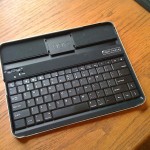
The ZaggMate keyboard
I love this. It just works. The keyboard is a little cramped, but ten minutes of practice and I am typing. One of my favorite features is that I can copy and paste on the iPad using the familiar Command-C and Command-V keystrokes.
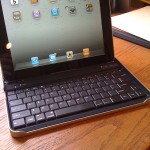
The iPad (horizontal, vertical also works) and the ZaggMate
This iPad thing keeps improving every month.
I took the accompanying photos with my iPhone.
Tags: iPad · Technology · Writing



