by Dwayne Phillips
A procedure for writing a novel from Jack Woodford.
Here is a procedure for writing a novel. Ouch, that probably hurts for a lot of people. “Procedure for creating the great American novel? Where is the art?” Well, from an engineer and an organized person, some sort of procedure is comforting. Take it for what it is – a tool. If it works for you, use it. If it doesn’t work for you, forget it.
This procedure is from Jack Woodford in “Trial and Error, A Key to the Secret of Writing and Selling.”
Write a synopsis: “The actual written synopsis should run somewhere between fifteen hundred and five thousand words. In it include no dialogue; no descriptions of anything; just the roughest and barest outline of the basic, fundamental story behind the novel.”
Start to form chapters from the synopsis: “Go over your synopsis and, with a pencil, draw rough lines between sections which seem to you naturally indicate chapters”
Form chapter pages: Copy the relevant material from the synopsis to separate pieces of paper. One piece of paper for each chapter. As you copy the material, add material as it comes to mind.
At this time, you will have one piece of paper for every chapter in the novel.
Your chapter pages will contain about twice as many words as your synopsis.
The entire novel is now set in your mind.
Add to the chapter pages whenever new thoughts come to mind. The chapter pages give you a place to put ideas.
Character dossiers: “Write a dossier on them (each major character) … which catalogues all object facts about them and suggests their subjective identities”
Describe the locale: Write a description of the locale or setting of the novel.
So there you have it. And as Woodford writes, “So far you have arranged the architecture in such a way as to make it almost fool proof. Anybody can write a novel if he goes at it that way.”
Tags: Writing
by Dwayne Phillips
Buy books? Sure, buy lots of the ones I have written. Read books? Go to the library. It works quite well, and you have already paid your part of the cost.
I read yet another blog post the other day about how awful it is that Americans don’t buy and read books. I’m not sure the source of these we-don’t-read-anything-of-any-substance statistics. This story says that 3 billions books were sold in an average year. With 300 millions Americans running about, that comes to ten books bought for every man woman and child in America.
Regardless of how we count books sold, let’s move to books read in a year. I can buy a book, read it, and loan it to a dozen people who then read it. That only counts as one book bought in that year. Hmmm.
And then there is the library. The library is a building full of books. The people who operate the library will loan you a book for a few weeks. If you want the book longer, they will loan it to you for a few more weeks. It is amazing.
When I was a kid, I attended a small private school. This was not a school for rich kids. Most of us attending were charity cases in that we attended for little or no cost (another story for another time). This little poor private school took us to the library often as the little poor private school didn’t have the money to buy many books.
There are public libraries. This is what most of us see on the street. If you pay taxes, you fund the public library. Since you pay for the library to exist, you might as well use it. Funny thing is, when the economy is bad, see for example right now, use of public libraries goes up (see this story and this one as well).
There are libraries at colleges. These are only open to people associated with the college. Well, that isn’t exactly true. Most college libraries are accessible in that a non-college person can walk onto the campus, walk into the library, pull a book from the shelf, and read it while sitting there. Maybe that isn’t always practical, but it is possible. A person could also inquire as to how involved you would have to be to qualify to borrow a book from a college library.
I live in Reston, Virginia. We have a Fairfax County Public Library here. It is a pretty good library in that it has a lot of books, convenient hours and location, and has inter-library loan with all the other libraries in Fairfax County.
Oh, inter-library loan. Some libraries do this. If you want a book that they don’t have, the library staff will check with another library. That library will loan the book to your library who will then loan the book to you. That is pretty nice.
Then there is the big one – the Library of Congress. Lucky for me, I can go to that one in person. It isn’t convenient. They won’t loan me a book to take home. I have to sit in the reading room, an awesome place, to read the book. And it really isn’t that convenient for me. It is at least an hour commute and the Metro costs $5 each way, and all that stuff.
The Library of Congress has an inter-library loan program. Perhaps your local library can borrow a book from the Library of Congress and loan it to you. That means you can read almost any book ever printed.
All this library talk is perhaps bad news for authors (like me) and publishers. It is, however, great news for the vast majority of us.
Tags: Library · Writing
by Dwayne Phillips
I have a virtual machine running on a Windows XP laptop computer with Ubuntu Linux running in the virtual machine. This is all using WMware’s WMware Player.
I had a problem at work where I needed a Linux-based computer to run a test. To be candid, I first saw this as an opportunity to buy yet another computer at work and load Linux. An administrator suggested I look at VMware Player from VMware. I tried it, and it all worked.
First, I downloaded VMware Player from this site. I downloaded version 3.1.2. I had to first create an account on VMware, and that was simple. I did this on a Dell Latitude laptop running MS Windows XP Pro Version 2002 Service Pack 3.
Next, I downloaded Ubuntu Server 10.04. I downloaded a special image for WMware Player from the thought police site (http://www.thoughtpolice.co.uk/vmware).
Now I installed everything:
- Start the VMware Player
- Create a New Virtual Machine – I point to the Unbuntu that I downloaded (ubuntu-10.04.1-desktop-i386.iso)
- 40 GByte disk size, SPlit virtual disk into multiple files
Then the install was complete and up comes Ubuntu. The installer created a folder on the PC at:
C:\Documents and Settings\dwayne.phillips\My Documents\My Virtual Machines\Ubuntu
with many small files.
And there you have it. Here is an image from my computer showing Ubuntu running in a virtual machine. Inside Ubuntu I am running Firefox, Gimp, and a terminal window. I am surprised how easy this was. Great.
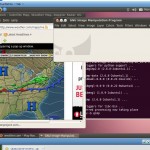 (click on the image to enlarge)
Now I am ready to run some Linux-based tests, at least I think I am.
Tags: Linux · Technology
by Dwayne Phillips
summary
I live in the Northern Virginia suburbs of Washington D.C. To be more specific, I live in Reston, Virginia – a planned community. This is a good place to live, have a family, find good jobs, good medical care, good entertainment, and so on. Just Google for “Reston 50 best places” to find all the best places lists that Reston has made.
Alas, I don’t live in RA – Real America. In RA,
- a corporation doesn’t cut the grass alongside the roads
- the roads aren’t repaved every other year
- there aren’t more doctors and dentists than, well, than anything
- there aren’t so many Federal government employees
- there aren’t so many companies whose lone customer is the Federal government
- there are dollar stores
Given time, I could make the above list much longer.
For much of the 28 years I worked for the Federal government I,
- was in a foreign country
- was in California
Neither of the above are in RA either.
RA is sometimes called the “flyover” part of the USA. People flyover it while going from one important place like New York or Washington to another important place like California.
I lived much of my life outside of RA because that is where my job was. I much prefer RA over the other places. Perhaps that is one reason why I enjoyed taking a walk and visiting the Grand Canyon this year and other such ventures into RA.
Tags: Culture · Family · Geography · Government · Grand Canyon
by Dwayne Phillips
Computer voting systems have proven to be insecure. I suggest building a secure one. The foundation would be a single-user single-task operating system (like CP/M). We could write this from scratch with very little money.
There have been recent notes on the net about the Washington D.C. online voting system that was hacked quickly (here is one of many links to the story). The hackers gained total control of the system, i.e., they could have given any candidate any number of votes and controlled all elections.
Good points: Washington D.C. was trying an open-source software voting system. Washington D.C. put the system up on the net for all eyes to see and test.
Bad Points: The system had huge security holes.
Good Point: These faults were found before anyone tried to use this in a real election.
We have been using computer voting systems for a few elections where I vote (the Northern Virginia suburbs of Washington D.C.). It is not confidence inspiring to see
- voting stations running Microsoft Windows
- technicians rebooting voting stations frequently
Let’s try this again. Let’s write a computer voting system that is secure. I really mean it when I begin with “Let’s try this again.”
- Start with a computer.
- Write an operating system for the computer.
- Write a voting system program for the computer and the operating system.
There are lots of computers that we can use. Some have touch screens; some don’t; they all have keyboards. Write a new operating system. The new operating system can only
- run one task at a time
- accommodate one user at a time
Yes, a single-user single-task operating system. I used to use one of these things; it was called CP/M (Control Program/Micro-Computer). I still have a computer in a closet at the house that runs CP/M. Early versions of MS-DOS were also single-user single task operating systems. No doubt some of the early operating systems from DEC (Digital Equipment Corporation for all you youngsters) were single-user single-task operating systems.
You see, a single-task operating system cannot have malware running in the background. Nothing can run in the background as only one task can run. Also, a communications program cannot run in the background because as stated earlier, nothing can run in the background. Hence, only the voting system program can run on the computer. The user can see that program running. Nothing is happening that is not visible to the naked eye.
This could cost a lot of money. Yes, it could as anything sponsored by the government could cost a lot of money. On the other hand, this could cost very little money. It could be written as an open-source project by volunteers. It could be inspected (reading the source code) and tested by volunteers as well.
I suggest starting from scratch. Take a blank sheet of paper, design the operating system, and write it. If that seems too daunting a task, start with a copy of CP/M and update it to use CD-ROMs instead of 160-KiloByte floppy disks. I don’t think this task is too daunting. I think some college sophomores could do it.
I wish this would happen. I doubt it will. There is too much money available for large, complex, expensive, fancy computer voting systems for people to use a simple, free system. Then again, there is hope. Perhaps one day people who make the decisions will decide on something that is secure by definition.
Tags: Ideas · Multitasking · Technology
by Dwayne Phillips
I continue to work with graduate students on their writing. I am working with engineering, computer science, and IT students. They continue to teach me.
This week’s learning concerns the variety of nouns and verbs. In novels and other fiction, the writer uses a variety of nouns. It would be boring to use the same noun for the same thing over and over and over and over. In technical writing, however, boring is better. If the writer writes “subject site” for a particular website, the writer should always write “subject site” when referring to that site. The reader won’t confuse which website the writer is describing. It will always be the same noun for the same thing.
This advice also holds for verbs. The writer may write “transfer” to describe moving data to a disk drive. The writer should always write “transfer” when referring to moving data to a disk drive. If the writer uses “transfer” one time, “move” another time, “write” another time, “transcribe” another time, and so on, it is much easier for the reader to become confused.
Technical writing is difficult; reading technical material is also difficult. There isn’t much the reader can do to make his job easier. There are a few techniques the writer can use to help the reader. Using fewer nouns and verbs is one.
Tags: Learning · Writing
by Dwayne Phillips
Well meaning managers often start new activities. The activities are not sustainable, and the well meaning manager gains a reputation as a liar.
I am a grandparent. I have one grandson who is now 23 months old (I have to put up a new photo of him sometime :-).
Grandparents engage in a lot of unsustainable activities with their grandchildren. Here are two examples.
(1) There is a pond near my house. When my grandson visits, I take him to the pond. I gather pebbles and and tosses them into the water. He loves to toss things and it is exciting to see the splashes as the pebbles hit the water. This is great fun; he laughs, and I laugh at his joy. This is not sustainable. You can’t stop and throw pebbles into every body of water you see. Just go into one of those restaurants that have huge fish display tanks. My grandson thinks he should be able to toss pebbles into the fish tanks. The other adults think otherwise.
(2) We have a bunch of old Disney cartoon movies on VHS tape. My grandson loves to listen to the songs. His favorite are the marching and singing elephants from the animated “Jungle Book” movie. When he asks, I play the tape for him. We laugh and sing and it is great fun. Needless to say, it is not a sustainable activity as you can’t always play a cartoon video tape on demand.
And what does fun with the grandson have to do with anything professional? I don’t know how many times I have seen well meaning managers start activities that were not sustainable. “From now on,” starts the well meaning manager, “we will have bagels on Monday mornings to eat during our staff meeting.” Within weeks the bagels disappear from the meetings. Within months the meetings themselves disappear. Neither was sustainable. I could go on with a few dozen more painful examples.
The result of promising to sustain unsustainable activities is that the well meaning manager comes to be seen as a blow hard. That is a polite way of saying you cannot trust anything the well meaning manager says. That is a polite way of say that the well meaning manager is a liar. Oh well, not a good result.
Please take care when starting something. At least preface the new activity with a kind of disclaimer like:
We will have Monday morning staff meetings. We will have bagels at the staff meetings. We will continue these until we stop them as often the benefit of such activities disappears.
I don’t state such a disclaimer to my my grandson. There is something about the grandfather-grandson relationship that eliminates the need for such a disclaimer. Somehow I have acquired an extraordinary status with my grandson. He was born with an extraordinary status in my eyes. The manager-employee relationship, however, does not enjoy such extraordinary status.
Tags: Expectations · Family · Management · Meetings
by Dwayne Phillips
I work with grad students who are writing their dissertations. Often the simplest advice and exercise is the most effective. Here is one of those exercises.
I work with graduate students in engineering and computer science at George Mason University. Most of the students are working on their dissertation proposals or dissertations. Many struggle with their writing. They are brilliant people, but the words don’t move from their brains to their paper easily or readily. One of the more frequent stumbling points is deciding what to say in a paragraph. Since they are struggling, they usually try to say half a dozen things in one paragraph.
Here is what I do in this situation.
Me: What do you want to say here?
Student: Uhh.
Me: Let’s try this. Don’t look at your paper. Look at me. Please tell me what you are trying to write here.
Student: Something brilliant, concrete, precise, specific.
Me: Great. Write those words.
Student: You mean I can do that. I can actually write just what I want to say?
Me: Yes, you have my permission to actually write just what you want to say.
The student usually sighs and smiles at this time. They then scribble notes with their pencil in the margin of their paper. Everything goes much easier after that.
Tags: Writing
by Dwayne Phillips

Me and my little book
After several years of drafting, waiting, drafting, revising, waiting, adding, waiting, revising … you know, the usual stuff … I finished (for now) a small book on experiential learning. The book is about a hundred pages long and is titled “Some Notes on Experiential Learning.” It includes:
- Some theory
- Tips for the instructor
- 80+ exercises
- 30 types of debriefing
- Questions to ask
Here are a few web sites that discuss experiential learning (here, and here, and here, and here).
An excellent place to experience experiential learning is the AYE Conference.
I published this little book at FastPencil.com. If you would like a copy, write me at d.phillips@computer.org. I can setup my FastPencil account so that the book would be available for direct purchase (less than $10). I could also email a PDF for a PayPal payment of $10. For me, the little published paperback format is so much handier to use.
Tags: Learning · Writing
by Dwayne Phillips
Sometimes I am stuck for a word while writing. Experience has taught me to put “thing” in the blank and move on. The right word will come later.
There we were, writing a proposal. Three of us were gathered around the keyboard, one typing the words, the other two contributing the words. We were flowing, moving, thinking, talking, putting words on the screen, a good proposal appearing in front of us.
Then it happened – we stopped.
We had a concept, something important, but we didn’t have the right word for it. We stuttered, hemmed, hawwed, grunted, and waved our hands all about (you know the kind of things guys do). We couldn’t find the word. What is worse is that all forward progress halted. Several minutes later, we didn’t have the word we needed and we were sitting there staring at one another and the screen.
This wasn’t the first time in my life that the search for one perfect word killed the flow of work. If I remember my own advice, it may be the last or at least it won’t occur often.
A solution:
Call the concept a “thing” and move on.
Yes, literally type the letters t h i n g and move on. You are progressing, you are working, your mind is clicking. Don’t stop. Continue putting words on the screen. The word you seek will come later. Perhaps the word will come in five minutes or five hours or five days, but it will come. If you stop writing and search for it now, there will be thousands of other words that do not come.
Tags: Design · Writing


