by Dwayne Phillips
Location has something to do with a person. It is, however, a small and maybe diminishing factor.
I live in Virginia. Start making assumptions about what that means. But first, ask yourself, “which Virginia?”
There are three Virginia-s:
- Federal Virginia
- Navy Virginia
- Virginia Virginia
I live in Federal Virginia and worked in the Federal government for 28 years before retiring from such last Fall (to go on and get a job with a government contractor). Federal Virginia, a.k.a. Northern Virginia, comprises the ever expanding suburbs of Washington, D.C. The area consumed is proportional to the size of the Federal budget. Bye, bye farmland. Most of the Federal government resides outside the confines of Washington, D.C. Most Federal workers live near their jobs and pray they never have to commute into “the district” to work.
Navy Virginia is in the southeastern corner of the state on the coast. I have visited there a few times in an official capacity.
Virginia Virginia, a.k.a. Real Virginia, is the remainder of the state. I had the pleasure of walking through most of it last year.
I also lived a lot of my live in Louisiana. People in New Orleans used to claim that there were two Louisiana-s: New Orleans and the rest of Louisiana. I never bought that one. I mostly felt that New Orleans wasn’t part of Louisiana, but that is another story.
I once lived in California for four years. How many California-s are there? A dozen?
All this goes towards a thought:
There is a lot of variation in location
Perhaps you have to go down to the zip code to understand something about a person when they tell you where they live. Perhaps you have to go to the ten-digit zip code? Maybe that doesn’t matter either.
Environment, the environment based on geographic location, has much to do with a person. It is, however, only one factor.
So the next time a person tells you they are “from New York,” “from Virginia”, or from anywhere, pause a while before making assumptions.
Tags: Culture · Geogrpahy
by Dwayne Phillips
The latest computer, the best desk and chair, even coffee brought to you while working – these are nice, but not the subject of this post. No, the most valuable asset a freelancer has is good health.
No Work No Pay
The reason I picked good health is simple: freelancers don’t have sick leave. If we are sick for a day, we don’t work, we don’t generate content, and we aren’t paid.
One or two days in bed is bad. Worse is a lesser sickness that cuts productivity for several weeks. Those lingering illnesses reduce the quality of our products, and keep us from recognizing this slide. We don’t realize that we are sick.
No One is Immune
I know two best-selling authors and consultants whose health recently cost them six months of work. They have been successful for decades and have more resources than most freelancers, e.g. access to excellent health care. Their six-month illnesses hurt their customers more than their own careers. Nevertheless, they serve as prime examples of freelancers, health, product, and income.
I have two brothers who freelanced for ten years each. Both now suffer from poor health, and neither of them is working at this time.
Things Freelancers Can Do
Buy Health Insurance: Health Insurance is not cheap, but is available for freelancers ($100 per month for an individual). The simplest way to obtain it is to be married to someone who has health insurance from their job. Absent that, buy health insurance for as many family members as possible. At least buy health insurance for the freelancer. This isn’t selfish; it is practical. When the freelancer is sick, there is no health care for anyone in the family.
A danger of no health insurance is that minor illnesses grow into major ones. Visits to the doctor for “little things” seem “too expensive.” One of my brothers allowed little health issues became big health issues which became major health issues. He eventually went to the emergency room and will never fully recover.
Keep regular hours: Many of us become freelancers because we want to set our own hours. Fine, but set the hours and keep them. Go to bed at the same time every day. Wake at the same time every day. Eat at the same time every day.
My second brother suffers from diabetes caused by years of irregular hours. Some days he worked 20 hours; some days he slept 20 hours. Some days he ate five meals; some days he was too busy working to eat anything. This blood sugar roller coaster damaged his health.
Measure your health: I weigh myself and take my blood pressure every day. My weight stays within a five-pound range even during the Christmas-New Year’s season. I regulate my blood pressure with medicine and close attention to diet.
Measure what is appropriate for you (blood pressure, blood sugar, etc.). Weigh yourself regularly – at least once a week. Fluctuating weight is an early indicator of many health problems.
One Tool
I recommend that freelancers keep a work logbook. A text file or spreadsheet will work, but I use a paper notebook (National Computation Notebook # 43-648). Record what you do every day, hour-by-hour. (7AM woke, 7:30 toast and coffee, 8AM blog research, 12:00 nap, 12:30…) Also record your health measurements.
Review the work logbook monthly. How do the health measurements compare to previous months? How regular are your working, eating, and sleeping hours? Surges in work happen and are signs that business is good. A chaotic life, however, is not good.
This probably sounds like your parents talking (it sounds like my parents). Regardless or because of my parent’s advice, I am blessed with good health, able to work, and hoping to continue such for many years to come.
Tags: Employment · Health
by Dwayne Phillips
I like writing exercises – things that make me think.
I came across a good one today from Kenneth Davis at ManageYourWriting.com. He calls it the Alphabet Shift.
choose a word you’ve written beginning with a letter from the first half of the alphabet. Replace it with a more effective word beginning with a letter from the second half of the alphabet.
I started to think of variations:
Choose a word that begins with a consonant, replace it with a word beginning with a vowel.
Choose a word that has an even number of letters, replace it with a word that has an odd number of letters.
Choose a word that names a place, replace it with a word that names a thing.
Choose a word that is strong, replace it with a word that is weak.
Choose a word with color, replace it with a word with sound.
Choose a word with taste, replace it with a word with scent.
Choose a word with thought, replace it with a word with touch.
We can double the number of exercises by flip-flopping each of the above. For example,
Choose a word beginning with a letter from the second half of the alphabet, replace it with a word beginning with a letter from the first half of the alphabet.
and so on…
And here is a bigger exercise for two groups of people. Choose a well known passage from a book.
To be or not to be, that is the question.
Roll a dice or use some method to pick a random number, e.g. 4. The 4th word in this passage is “not.” That word begins with a consonant, so replace it with a word that begins with a vowel. Keep selecting other words in the saying letting the groups take turns with word swapping exercises.
How long can this go on?
Tags: Communication · Learning · Writing
by Dwayne Phillips
My grandson taught me about the physical limitations of eBook readers. Those limitations are real. This points me back to the best use of eBook readers – holders of workplace documentation. I wish we would go back to the projection glasses that people tried a couple of decades ago. I guess the market for such isn’t profitable.
I have spent time with my son, daughter-in-law, and grandson this past weekend. One thing we did was read my grandson a little book. At the last page of the book, I was told that I was supposed to hug my grandson with the book. The book is made of fabric. The last page is especially soft, fuzzy, and cuddly. When you read that page, you hold it close to my grandson and hug him. My daughter-in-law started this tradition with this book. She is the most wonderful daughter-in-law in the world. With continued blessings, I look for to two more such wonderful additions to my family.
Anyways, I cannot figure out how I could hug my grandson with a Kindle, a laptop computer, or any other eBook reader. They just aren’t soft, fuzzy, and cuddly. As much as I like technology, I have to admit:
There is something to the physical nature of reading
Paper has texture, stiffness, strength, thickness, and many other things that can only be sensed by touch. As with my grandson’s book, there are many other physical materials that comprise books. Each has its own special use and conveys a message of its own. The Kindle for all its advantages, cannot duplicate these physical messages.
This brings me to the one use of eBook readers that I have recommended for the past ten years.
eBook readers are great for workplace documentation
For many years, I traveled the world installing and maintaining systems. Along with the systems themselves came trunks filled with manuals. What a pain, what a chore, what in the world were we doing? Online documentation works in many cases, but there are many more instances where it is not available. The eBook is a great answer.
The Kindle is good, the newer larger Kindle is better for these applications. Both, however, fall short of what we were trying to do 25 years ago. I want to wear a pair of glasses that project the documentation in the space in front of my eyes. That doesn’t require any hands or any special lighting. I merely point my eyes in a specific direction, and there are the words and diagrams I need to do my job.
Maybe one day we will proceed back a few decades and resurrect what I believe to be the best use of eBooks.
Tags: Communication · Design · Technology
by Dwayne Phillips
Management actions and lingo are nice. They are not, however, as effective as simple friendship.
In a recent job, we had a traditional organization arrangement where the engineers built systems and the operators used the systems. Managers divided this arrangement into smaller parts or “branches” of six to ten people by the type of system the engineers built and the operators used. In an effort to ensure that the engineers built systems that the operators would actually use, the managers arranged the office space to reflect the organizational structure.
Are you still with me through all this management arranging? Please bear with me a little longer.
I worked for the engineer manager Ed. The operator manager was Oliver. During all the office moving and such confusion, I grabbed a circular table and half a dozen forgotten chairs and set them in an open space outside of Ed’s and Oliver’s offices. Everyday some of us ate lunch at this table. Imagine, engineers and operators eating lunch together daily. During lunch, Ed and Oliver became friends. They were of similar age, family situation, and life experiences.
Senior managers walked through one day, and not having anything else to do, noted that the open space with a circular table and half-a-dozen forgotten chairs could hold a set of cubicles. Despite my protests and admonitions to the contrary, the senior managers replaced our gathering place with impersonal cubicles.
Yes, these were the same managers who wanted the engineers and operators to work closely together. These same managers removed the one item (which cost nothing) that brought these two groups together. But that is not the point of this story.
With the open space gone, lunch moved into either Ed’s or Oliver’s office. The camaraderie among the engineers and operators continued; the friendship between Ed and Oliver grew. Ed, Oliver, and several engineers and operators even began to play games together at night on the Internet. They all bought compatible game consoles and played some WW II game or other. They would play together three and four hours a night five and six nights a week.
In the midst of all these lunches, games, and friendship something predictable happened:
Oliver’s operators were using the systems built by Ed’s engineers.
Ed’s engineers were building the systems that Oliver’s operators wanted.
The mission was succeeding. The “new” organizational scheme of seating engineers and operators near one another was a management triumph. Such needed to be replicated to other parts of the greater organization.
Senior managers moved Ed to a second building and Oliver to a third building. Surely, that would spread the good work. Ed and Oliver remained friends. The people left behind in the first building didn’t work together as well any more.
I suppose now is about the time to bring a moral to this all-too-true story:
Friends do things that help one another, so the mission is likely to be successful.
All that management stuff is nice, but is not nearly as effective as letting friends work together.
I wish that I could bring this story to a happy ending. Alas, wishes and happy endings are left to fairy tales, not true-life office and management dramas.
Tags: Management · People
by Dwayne Phillips
For writers and those who name products and services: standard items have shorter names than special ones. Attach modifiers to exceptions to the rule, not the rule.
Apple recently changed their line of laptop computers. As expected, the newer computers have more performance and a lower price than last year’s models. In addition, Apple changed the name of one computer from “MacBook” to “MacBook Pro.” The name change gives Apple one model called MacBook and three models called MacBook Pro.
Whoa! Stop here: one MacBook, three MacBook Pro.
The writer and logical engineer in me shudders. It seems that henceforth journalists, bloggers, and typists of all kinds will have to type that extra p-r-o three times more often than not. That isn’t right; that is extra work and extra effort. That is a waste.
I don’t recall reading it anywhere, but surely out there somewhere is a convention of naming or branding something that states:
The rule has a shorter name than the exception.
Stated another way:
Name the exception by attaching a modifier (adjective or adverb) to the rule.
Hence, Apple would call the three computers MacBook and attach a modifier to the one computer and call it something like “Little MacBook,” “MacBook Lite,” “MacBook Home,” or such.
So as not to seem anti-Apple, there are other examples of confusing the rule and the exception. The U.S. Congress, never to be surpassed by anyone in the misuse of the English language, confuses the names of time shifts. The time we use five months of the year is called “standard.” The time we use seven months of the year is “daylight savings.” How can standard occur less frequently than special?
Again, there must be a convention out there somewhere which states:
Apply the title “standard” to that which occurs most often.
Apply special titles to all other situations.
Hence, the time we use from the second Sunday of March to the first Sunday of November (7 3/4 months in 2009) would be called “standard” time. The rest of the year would be called “Daylight Wasting,” “Less Daylight,” or simply “Dark.”
I doubt that any of the changes I recommend will come to pass – especially the one involving Congress. I do, however, feel much better now that I have posted these recommendations.
Perhaps one day, someone with a slight grasp of English will be elected and rise to some seat of importance in the U.S. Congress. Maybe the current U.S. Congress could hire a retired English teacher part time to help them with names and such.
Tags: Culture · Government · Writing
by Dwayne Phillips
The digital devices we have can dominate our lives. That still doesn’t change a simple fact – this is an analog world inhabited by analog people.
We live in a digital world. Cell phones, Internet, digital cameras, digital video camcorders – all digital.
At its heart, the digital world comprises only two states: on and off, the one and the zero. The classic black and white. There are no shades of gray in here.
For many of us, this black and white won’t work. We want shades of gray, we want all the colors of the rainbow. We want some places in between where we can fit our individual preferences so we can be a little different and yet remain comfortably similar.
Setting preferences aside, we know the world is not on or off, one or zero, black or white. There is no edge to a drop of water or that distinct point in time when a child’s laugh changes to a cry. Those edges between two opposites don’t exist.
The digital world, however, lures us into believing that the one-zero world can exist. Enough ones and zeros approximate an analog world. Our computer screens have 16 million colors. Surely that is enough. What do we want, 16 million and one colors?
16 million colors are not good enough. We do want more; we can imagine mixing colors number 16,000,000 and 15,999,999. The heart and soul long for such.
And then there are all the people in the world. They are analog as well. They are a shade of happy one day and sad the next. They flip; they flip halfway, and they flop. They flip back and forth but never in a predictable or complete manner. The rules of digital logic don’t apply. What am I to do with these people?
I find myself more productive and at peace on days when I accept that the world and its inhabitants are analog. I expect mixtures of color and behavior. I expect the unpredicted. In a sense, that enables me to predict the unpredicted. Is that logical? Probably not, but it makes a circle in my thinking, and a circle is analog.
So I live in this analog world. I use all my digital tools to navigate my future path and record my past life. These digital tools are quite powerful, convenient, and useful. They, however, are only tools. I use them now and then in an analog manner for this is, after all, an analog world.
Tags: Culture · Logic · People · Uncategorized
by Dwayne Phillips
The current administration is running into all sorts of obstacles that it didn’t have during its campaign. There are countless “stupid rules” inside government. These rules were created because at some time in the past someone cheated. Cheaters are the origin of rules and regulations.
The Obama administration has been criticized for not using Web 2.0 technologies now that it is in the White House. They used so much of these technologies during the campaign and promised to keep using them once elected. What has happened?
For one thing, the campaign had 177 staffers in this area – the White House has 10 staffers. Ooops, having one-eighteenth the staff will slow you a bit.
Simple, staff up, hire people. After all, we have spent a few trillion dollars since the election. What’s the big deal? Well, in government, staff size is limited by budget for staff (not overall budget). As I always heard, “Those are two different pots of money.” Congress has to budget for more White House staff. That takes a while.
Simple, use volunteers. There are plenty of qualified people who will volunteer a few hours a week to contribute to the Web 2.0-in-the-White-House effort. They can do it from the far-flung corners of America over the web. They know how to do that.
Well, the Federal government is limited in what it can do with volunteer not-for-pay efforts. The IT guys at the White House cannot grant access to the systems in the White House to non-employees.
This little fact startles most people.
The government cannot accept volunteers.
At one time it could, but, you know the old story:
- someone sent in volunteers
- the recipients of the volunteers gave favors back to the donors
- corruption and all that ugly stuff followed
- someone had to stop the corruption
- they passed a law or rule or regulation against volunteers
What a pity. This illustrates an old adage inside the government:
Every time you find a stupid rule, you can trace back to a time when it didn’t exist, but someone cheated, so the stupid rule was created.
So much of American government and society was created assuming that people would behave; they wouldn’t cheat or steal or take advantage of others. Every little cheat ruins the American ideal. If you see someone taking a shortcut or running through a loophole, remind them of this.
Tags: Culture · Government · People · Web 2.0
by Dwayne Phillips
One group of leaders can ruin a decades-old organization in only a couple of years. I have seen several examples personally. Harvard University is one example in the recent news. Leadership is difficult. It seems wise to limit the power of any one group of leaders.
One group of leaders can do much for an organization – for good and for ill. In particular, one group of leaders can cripple or ruin what has historically been a successful organization.
Example (no names in the first two examples to protect the guilty): In the 1980s, a successful West Coast Defense contractor (several decades old) brought in a new CEO. The new CEO had a vision for the future of
the company. He pushed his vision into the company changing its technical direction completely. In two years the company was almost bankrupt.
A similar example: In the 1990s another West Coast company – this one building computers – that has been successful for several decades brings in a new CEO. This CEO changed the direction of the company, and (you guessed it) in two years the company was almost bankrupt.
Yet another example: A community organization continues to thrive after several decades of steady growth. The president of the organization retires and moves out of the community. New officers are elected. In two years, the organization struggles to function.
Yet another example from the news: Harvard University struggles. The endowment (still the biggest for any school in the world) has shrunk in half of what it was three years ago. Risky investments and bad interest-swapping schemes have proved catastrophic. Sure, lots of people have lost money in investments in the last 18 months, but compare Harvard now to the Great Depression. Harvard’s endowment grew during the Great Depression.
Every time a hundred-year-old private college closes, every time a decades-old business declares bankruptcy, every time an organization with a history of success fails – look at the current leadership. What can take decades to build can be ruined in just a couple of years.
Leadership is difficult and fraught with many perils. Choosing leaders is more difficult. Who knows where a new leader will take an organization? By the way, one of the leaders of Harvard during its financial fall is Larry Summers. He is now chief economic adviser to the President of the United States. I trust that he will do better in his current position.
Perhaps those men who wrote the Constitution were right in putting in all those checks and balances and limiting the powers of any branch of government.
Tags: Government · Judgment · Management
by Dwayne Phillips
I often see poor photographs of technical products on the Internet. Today I saw an excellent image that communicates much about this product from Nvidia.
One of my frequent complaints about photographs of technology is the lack of scale. Someone will show their “new, smaller footprint widget” sitting on a nice, shiny table top. The widget sits there in the middle of a surface with nothing next to it. I suppose anything else in the photo would draw my attention away from the widget.
The trouble is, I cannot tell how big the widget is. They are showing this great photo so I will be impressed by how they shrunk the technology, but I have no idea how much they shrunk it.
Would it be that difficult for them to put a ruler next to the widget on the table top? If they don’t want to put an ugly ruler in the photo, how about some common object like a paper clip or a set of car keys – one with a cool logo like BMW or Porsche?
I saw a photo this morning that impressed me in a good sense. Nvidia is showing off their new really small computer on a really small circuit board. Here is there photo.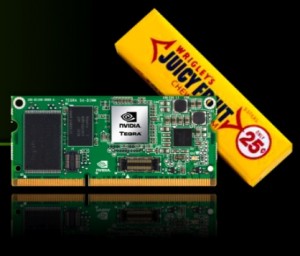
This is a gorgeous photo. Look at the reflection of the circuit board on the table. Look at the colors. Wow!
This is excellent communication in an image. I know how big the circuit board is. I can relate to the pack of gum. And see how the pack of gum adds to the image in other ways. It points upwards (hint, you systems can go up as well). The color brightens the image with yellow, red, and white.
Please everybody – take note of this. Use similar principles in your photos of products.
This photo belongs to Nvidia. I copied it from a CNET News story about Nvidia’s new system. I don’t think Nvidia minds me for showing this and advertising their product. I don’t think CNET News minds me for advertising their fine web site of technology news.
Tags: Communication · Image

